
In-House Accounting vs Outsourcing: What Works for Small Businesses in India?
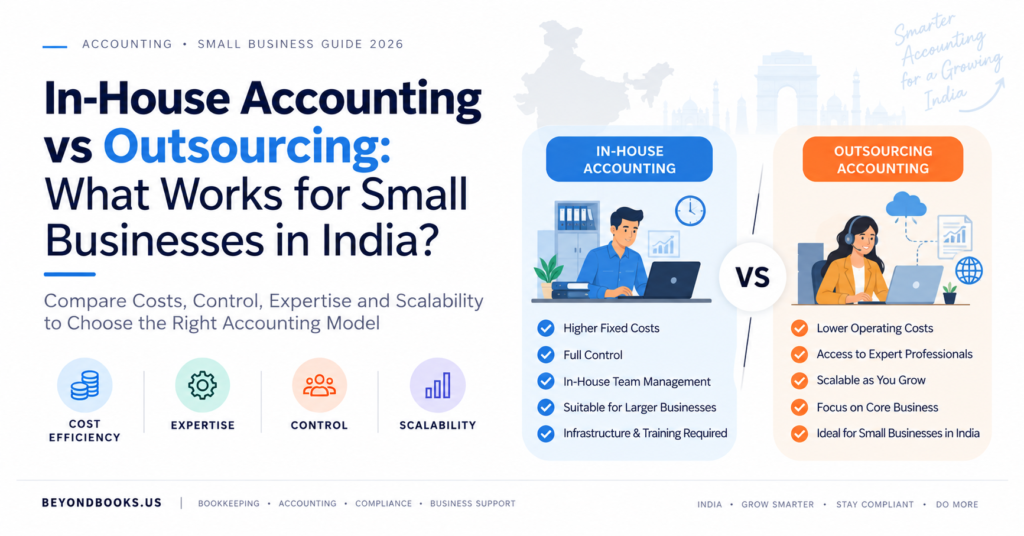
In-House Accounting vs Outsourcing: What Works for Small Businesses in India? In-house accounting vs outsourcing is the most consequential operational decision a small business owner in India faces when setting up or scaling their financial operations. Hiring a full-time in-house accountant for a small business in India costs ₹3 lakh to ₹7 lakh per year in total employment cost — salary, Provident Fund, ESI, bonus, gratuity, and leave — and delivers one person’s expertise, availability, and attention. Outsourcing to a CA firm costs ₹96,000 to ₹3 lakh per year for a comparable or broader scope of services and delivers a team of professionals — a bookkeeper, a GST specialist, a TDS expert, and a supervising Chartered Accountant — with built-in backup, compliance calendars, and professional liability coverage. For most small businesses in India with annual turnover up to ₹10 crore, outsourced accounting delivers lower cost, higher compliance accuracy, and better access to professional expertise than an in-house hire. CA Nainit Savla provides integrated accounting services to small businesses across Mumbai and India, and this article breaks down every dimension of the comparison so you can make the right choice for your business. Annual cost, head to head In-house accountant ₹3 lakh – ₹7 lakh a year, total employment cost Outsourced CA firm ₹96,000 – ₹3 lakh a year, team-based coverage For a small business with annual turnover up to ₹10 crore. Full workings below. On this page What Does It Really Cost to Hire an In-House Accountant for a Small Business in India? How Much Does It Cost to Outsource Accounting to a CA Firm in India? How Has Small Business Accounting in India Evolved Over the Past Three Decades? What Does the Side-by-Side Comparison Look Like for a Typical Indian Small Business? What Are the Steps to Transition from In-House Accounting to an Outsourced CA Firm? When Does Keeping Accounting In-House Make More Sense for an Indian Small Business? Frequently Asked Questions About In-House Accounting vs Outsourcing in India What Does It Really Cost to Hire an In-House Accountant for a Small Business in India? The cost of hiring an in-house accountant goes far beyond the monthly salary. Indian employment law imposes statutory obligations — Provident Fund, Employee State Insurance, professional tax, gratuity, and bonus — that add 25% to 40% on top of the base salary. Understanding the true all-in cost is essential for an honest in-house accountant vs CA firm comparison. Base Salary: An accountant with 2 to 5 years of experience, proficiency in Tally or Busy, and working knowledge of GST and TDS earns ₹18,000 to ₹30,000 per month in most Indian metro cities. In Mumbai, Delhi-NCR, and Bangalore, the range is ₹22,000 to ₹35,000 per month for a competent accountant. Semi-qualified Chartered Accountants (CA Inter-passed) command ₹25,000 to ₹40,000. At the ₹25,000 per month midpoint, the annual base salary is ₹3,00,000. Employer’s Provident Fund Contribution: The employer contributes 12% of basic wages plus dearness allowance to the Employees’ Provident Fund under the EPF Act, 1952. On a monthly basic of ₹15,000 (the PF contribution ceiling for most small businesses), the annual employer PF cost is ₹21,600. If the accountant’s entire salary is treated as basic (common in small businesses), the PF liability increases proportionally. The employer also contributes 0.5% toward the EDLI scheme and pays administrative charges of approximately 0.5% — adding approximately ₹1,800 per year. Employee State Insurance: If the accountant’s gross salary is ₹21,000 per month or below, the employer must contribute 3.25% of gross wages to ESI. At ₹21,000 per month, the annual ESI cost is ₹8,190. For accountants earning above ₹21,000 per month, ESI does not apply — but this threshold means that junior accountants in smaller cities fall within the ESI obligation. Statutory Bonus, Gratuity, and Leave: Under the Payment of Bonus Act, 1965, every employee earning up to ₹21,000 per month is entitled to a minimum bonus of 8.33% of basic wages (with a maximum of 20%). Annual bonus cost at the minimum rate on a ₹3,00,000 salary is ₹24,990. Gratuity liability accrues at 15 days’ wages for every completed year of service under the Payment of Gratuity Act, 1972 — while not payable until 5 years of continuous service, the accrual represents a contingent liability from Day 1. Paid leave — typically 12 to 18 days of earned leave plus sick leave and casual leave — adds 5% to 8% of salary in wages paid for time not worked. Software, Training, and Infrastructure: An in-house accountant needs accounting software (Tally Prime at approximately ₹22,500 one-time or ₹9,000 per year for renewal, or Busy at similar pricing), a computer (₹25,000 to ₹40,000), a desk and office space (a portion of your rent), internet connectivity, and periodic training on GST updates, income tax changes, and software upgrades. These costs add ₹15,000 to ₹40,000 per year depending on your setup. The Total: When you add base salary (₹3,00,000), PF (₹21,600), ESI (₹8,190 if applicable), bonus (₹24,990), leave cost (₹18,000), software and infrastructure (₹25,000), and recruitment cost amortised over 2 years (₹10,000), the all-in annual cost of a mid-level in-house accountant in India is approximately ₹4,08,000 to ₹5,50,000 — and in metros, ₹5,50,000 to ₹7,00,000 for an experienced hire. This is the number that must be compared against the accounting outsourcing cost India to make a fair evaluation. Companies that also need payroll management and GST compliance must add those functions to the in-house cost if the same accountant is expected to handle them. How Much Does It Cost to Outsource Accounting to a CA Firm in India? Outsourced accounting for small business India is priced based on the scope of services, the monthly transaction volume, and the number of compliance returns the firm handles. Unlike an in-house hire, the outsourcing fee is a single, all-inclusive monthly charge with no hidden employment costs, no statutory contributions, and no leave or attrition risk. Basic Bookkeeping and GST Filing ₹8,000 to ₹15,000 per month This covers daily or weekly transaction recording in Tally, Busy, Zoho Books, or
